Small Cat Conservationists Hail Uganda’s new Echuya Forest
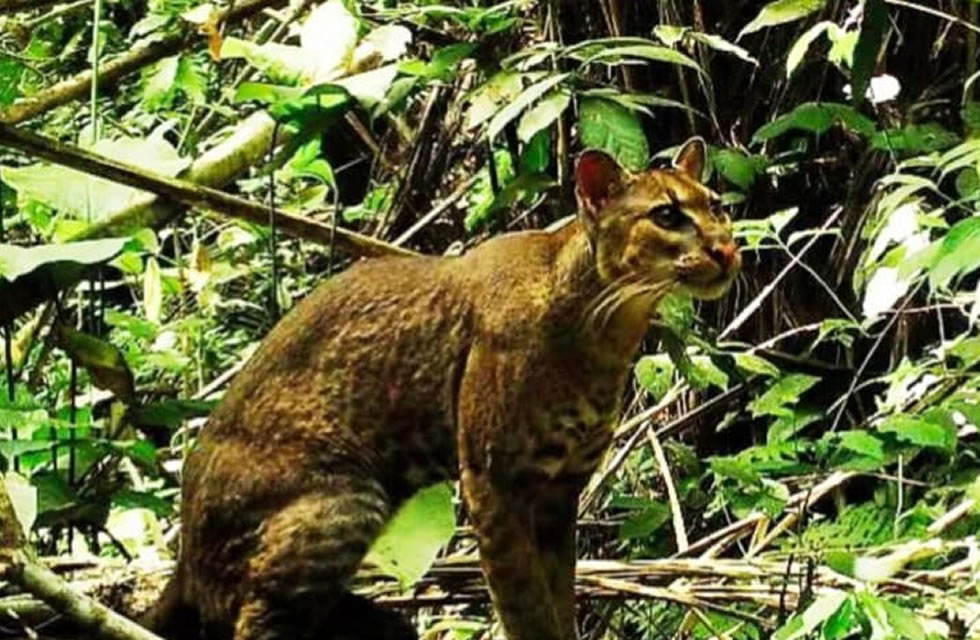
In what’s being called immensely good news for the African golden cat, often described as the continent’s most elusive and threatened wildcat species, Uganda’s Echuya Forest will become a national park.
“Having Echuya elevated to that level of protection is massive,” says Badru Mugerwa, founder and director of Embaka, an NGO, and of the African Golden Cat Conservation Alliance (AGCCA). “The African golden cat is one of those species that are being pushed to extinction in the forest.”
Besides the African golden cat (Caracal aurata), it’s also a win for a multitude of other species, he adds, as Echuya is home to more than 100 bird species, many of them endemic to the region, as well as to baboons (Papio anubis), blue monkeys (Cercopithecus mitis) and other mammal species.
The Echuya Forest covers around 3,400 hectares (8,400 acres) in Uganda’s extreme southwest near the Rwandan border, and is split between the districts of Kisoro and Rubanda. It’s currently a protected reserve. The declaration elevating it to a national park is part of a wider announcement by Uganda’s government as it creates six new national parks, bringing the country’s total to 16.
The news of this added level of protection is welcome, says Emmanuel Akampurira, deputy director of the Embaka Echuya Project, who notes that numerous threats have persisted in Echuya in recent years, degrading the forest and impacting African golden cats and other species.
The biggest threat, he says, remains indiscriminate snaring by hunters targeting antelopes and bush pigs for bushmeat consumption and small-scale trade in the forest. Inadvertent trapping of golden cats, combined with pressure on this patch of habitat from the harvesting of natural resources, forest degradation, and climate change, has put this forest-dependent cat under severe pressure here.
Surveys conducted by Mugerwa’s team in 2014 and 2015 suggest that the status of African golden cats in Echuya Forest is perilous. While in nearby Bwindi Impenetrable National Park it took only three days of camera-trapping to snap one, it took about 90 days of efforts just to record one of these cats on camera at Echuya. Over the course of the next year his team plans an extensive camera-trapping effort in the forest to pin down its current population numbers and densities.
It’s hoped that the new national park status can turn that high-risk situation around. Mugerwa says his team’s data indicate such protected areas can act as strongholds for this species in Uganda and possibly elsewhere in Africa.
“Even with camera traps, we are seeing really low detections of the species in forest reserves compared to national parks,” Mugerwa says. “We believe that protected areas, especially national parks, remain the strongholds for the African golden cat.”
Balancing community needs with conservation
Mugerwa also says his organization’s efforts to raise the African golden cat’s profile, and the actions of other organizations in Echuya, such as Nature Uganda and the Institute of Tropical Forest Conservation, have helped build the case for the new national park.
Since 2015, Embaka has sought to address threats to the African golden cat by working closely with hunting communities to identify their needs. This includes providing goat and sheep “seed banks” to community members, particularly former hunters, as a way of promoting alternatives to bushmeat. These work by donating the first newborn goat or sheep to the owners’ neighbors. The NGO has also started community savings and loan associations (known as Conservation Pesa, the Swahili word for “money”) to enhance quality of life, and helped organize community soccer matches to build goodwill between conservation groups and local people.
It soon plans to offer free oral health care and dental treatment (dubbed Smiles for Conservation) to community members, done as an incentive to inspire local support for conservation projects that Embaka and AGCCA are implementing in other forest habitats of the African golden cat.
“Through these activities we have been raising awareness and engaging with communities to talk to people about conservation of the African golden cat and the entire conservation of the forest,” Akampurira says.
Jane Amumpaire, natural resources officer with the Rubanda district government, notes that the new national park will also bring opportunities for tourism, benefiting local communities. The government, she adds, plans to duplicate a revenue-sharing method used elsewhere in Uganda, including at Bwindi National Park, distributing a portion of park income to nearby communities.
“As a conservationist, I think it’s a good approach to make sure that there’s thorough management of the forest, and that [the government] reward[s] the communities that are living near the park, so that they can see the benefits of conservation,” Amumpaire says.
Though hailed as a conservation win, the new park declaration has been met with skepticism by some communities with which Embaka works, Akampurira says. Especially unconvinced are the Indigenous Batwa peoples, who depend on the forest for their livelihoods — obtaining honey, firewood and medicinal plants there for use and sale. But Akampurira says he believes community access to the forest arranged under the new national park may offer a solution. “This is a challenge that could be overcome,” he says.
Others have expressed concern that Echuya may become a site for the translocation of animals, such as elephants, giraffes and rhinos, raising fears of human-wildlife conflict. “It’s a little bit of a mixture of excitement and also of skepticism from the communities,” Akampurira says.
While the national park announcement presents some challenges to be overcome, Mugerwa says he’s confident the designation will bring greater protection for Echuya Forest, the possibility of expanding projects to support more communities, and will gain the attention of other NGOs and stakeholders.
“It’s definitely a win for conservation,” he says. “And hopefully moving forward, we may be able to replicate some of the numbers, or the densities, of African golden cats we are seeing elsewhere.”
Source: Mongabay News